
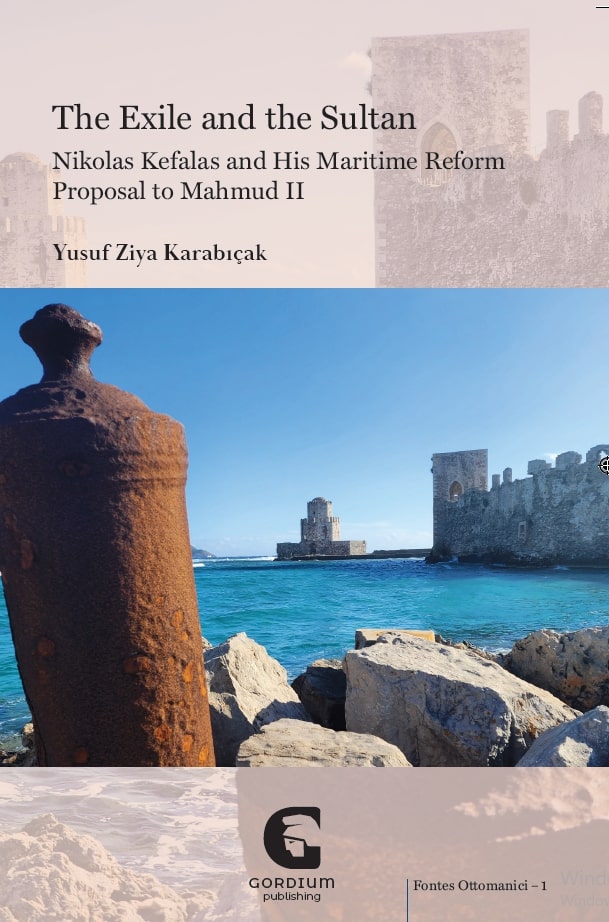
FONTES OTTOMANICI - 1
In this book, Yusuf Ziya Karabıçak examines the remarkable life of Nikolas Kefalas (1763-1847), an Ottoman Greek sailor, cartographer, merchant, pirate, writer, and reformer who transcended the borders of empires in the turbulent Mediterranean in the Age of Revolutions. By tracing documents scattered across various archives, the work pieces together Kefalas's story, offering a window into the vast Mediterranean world during the Age of Revolutions, where loyalties were fragile and sovereignty was constantly redefined. The book includes a lengthy introductory essay in English that examines Kefalas's life and activities within their historical context, as well as a transliteration and the English translation of a treatise Kefalas wrote shortly after the Greek Revolution and presented to Sultan Mahmud II in 1830. This treatise opens up discussions on many issues that would later shape the Tanzimat period. Kefalas's thoughts on issues such as the nationality of non-Muslims, social privileges, justice, governance, and the protection of foreign states offer clues to the fundamental tensions that would shape the reforms implemented in the Ottoman Empire in later years.
"A modern-time
Ulysses sailing the troubled seas of warring empires and nations, a man for all
seasons navigating the politics of the Age of Revolutions, Captain Nicholas
Kefalas roamed the globe in his quest for fame and success. Like so many other
adventurers in a world and time where identities were fluid and allegiances
fickle, Kefalas’s deeds and writings perfectly illustrate the volatile
environment of the post-Napoleonic era. Yusuf Ziya Karabıçak retraces the life
of this extraordinary character, before thoroughly examining an unpublished
memorandum from 1830, through which, after years of advocacy of the Greek
Revolution, Kefalas submitted to Sultan Mahmud II a program for reform based on
the integration of non-Muslims, particularly Greeks, into his empire. Although
it was evidently shelved, this project foresaw the upgrading of the navy,
protectionist measures against foreign trade privileges and capitulations, and
a revision of the status of non-Muslims with prophetic undertones of the
Tanzimat decree. A fascinating read to understand the complexity of one of the
most understudied periods of Ottoman history."
Edhem Eldem,
Columbia University (Sakıp Sabancı Visiting Professor)
"In this book,
Dr. Karabıçak captures a novel trend in historical writing: global
microhistory. Through his meticulous multilingual and multiarchival research,
he unearths the story of an Orthodox Christian with many talents who navigated
the Age of Revolutions. Though exceptional, this protagonist’s experiences and
narratives provide readers with valuable insights into the era of global
transformation."
Masayuki Ueno,
Osaka Metropolitan University
"Captain Kefalas
was a traitor to some, a wandering schemer to others, and a pirate and charlatan
to everyone. Using a fascinating document, contextualized in a well-researched
introduction, Yusuf Karabıçak takes Kefalas seriously because of what he could
and could not imagine, and combs out traces of disappearing imperial worlds and
symptoms of the world of nations to come. This fascinating life tells us about
the ways in which individuals faced ever-narrowing options and were forced to
make new choices in an age of nationalism – until some had no choices at all.
This is a fine snapshot of an age of revolutionary change."
Yanni Kotsonis,
New York University
Yusuf Ziya Karabıçak is a JSPS International Research Fellow at Osaka Metropolitan University. He received his PhD from McGill University and the École des Hautes Études en Sciences Sociales, and has held research fellowships in Germany, Greece and Japan. His work focuses on Orthodox Christian populations of the Ottoman Empire, the Orthodox Patriarchate of Constantinople, Ottoman diplomacy and political concepts in the eighteenth and early nineteenth centuries.
© 2023 GORDIUM